
Master the proven 9-step complete website development process. Stop wasting time; build professional sites faster. Learn the complete guide today!
In today’s digital age, a website is very important to take any business online. Today, most people spend most of their time online, so if a business wants to become a brand, it has to go online, so a beautiful website is very necessary for it. In this post, you will know the complete step-by-step website development process.
What is website development?
What is a website, and why should we make it? A website is the digital identity of a business or brand where all the information, images, and videos about that business are kept together in a domain name, which is connected to a hosting server, and all the data is collected in the server.
When a customer searches by typing that domain name in a browser, he can find everything about that business and see that website all over the world. So a website is the digital identity of a business.
Website development is when a developer collects all the information about a business from the client and organizes all the information neatly within a domain name according to the structure; then it is called website development.
Why do we learn the website development process?
When a professional website developer is ready to create a beautiful website for a client, he creates a website by following all these website development processes. So if you follow all these steps, then you will not have to face any big problem later. Every website developer should follow these 9 steps to develop a website. Today you will also know the website development processes step by step.
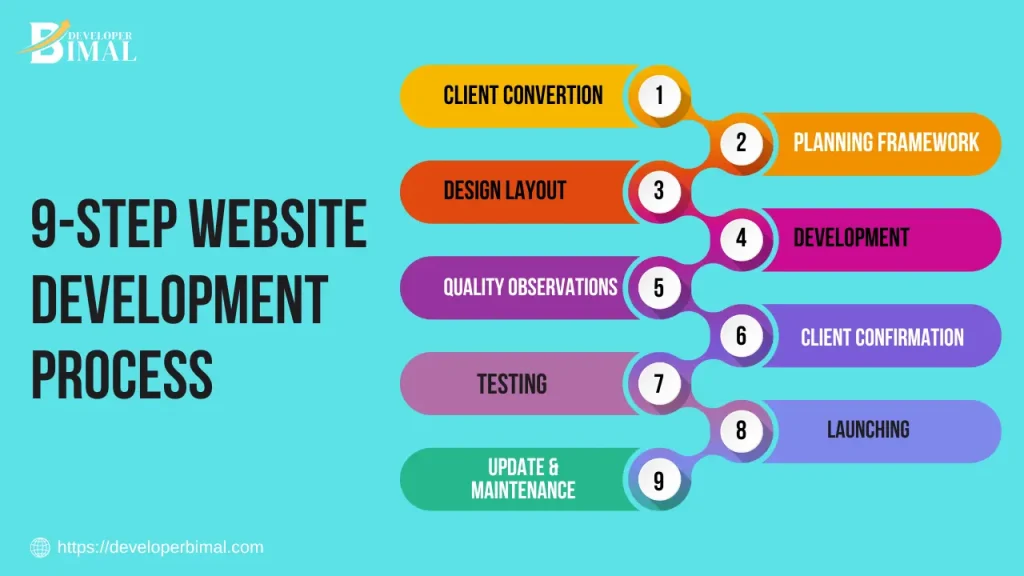
9 steps complete the advanced website development process.
1. Client Conversation
Client conversation is an important part of the website development process. When a client wants to take his business online through a website, then it is necessary to communicate well with him and understand everything about his business. Because how trustworthy a business website will be depends on the developer.
It is necessary to understand well what the client wants to put in his website. So first you know everything about his business in detail and think if you can give him what he wants and then start the rest of the processes. Because the price and time of the project are decided according to the client’s requirements.
2. Planning The Framework
Once a good conversation with a client is completed, then prepare the framework of the website you will build. Research deeply about the audience, what kind of things the audience of the business whose website you will build wants, and what kind of products or services will attract them, and plan all that.
Research well about what will be on the website and how to arrange and develop it so that the customer will be more attracted to all those things and create a framework, then go to the next step of the website development process.
3. Design website layout
After preparing a framework by researching deeply, prepare a wireframe or design layout so that you can visually see the design to see how it looks exactly and whether you need to change anything.
Prepare a prototype of the website that the client wants, and you will be able to better understand whether the website is working properly or not. If the client likes your design, then you can move on to the next step of the website development process.
4. Development
After the previous steps are completed well, the next important step is development. Website development has two parts: one is frontend development (HTML, CSS, and JavaScript), and the other is backend development (PHP and Python). If a developer works with both sides, he is called a full-stack developer.
If you want, you can create a website using any CMS (Content Management System) and plugins. While designing the client’s website, keeping in mind all the previous research, what kind of headline should be given on the website, what colors, images, and videos should be used, and everything else should be decided.
5. Check the work quality
While developing a website, it is very important to check the quality of the code. Because if you write any wrong code, you can easily fix it by checking it occasionally. If the quality of the code is not good, all the functions will not work properly.
There are many tools and extensions on Google with which you can check the code of your project. Frontend development tools (such as : ESLint, JSHint, HTMLHint, and Stylelint). Backend development tools such as : ESLint, Pylint, PHP-CodeSniffer and the extension SonarLint. Check the quality of your work with these so that the codes are 100% correct.
6. Client Confirmation
When the website development process is complete, it is necessary to know whether the work is matching the client’s requirements well or not; for this, all the work is shown to the client, and confirmation is taken from him. It is necessary to check whether there is any mistake in the project. Then the next step is testing.
7. Testing
Before making the project fully live, test it thoroughly so that all the mistakes are caught. You need to see if the website is mobile responsive and SEO friendly. Because once the project is launched, if you edit the project again, many problems can arise, so test everything and verify.
8. Launching
The most important step in the website development process is launching. After all the work of the website is done, the site is made live to the whole world, and people from all over the world will find that business online.
As important as the previous steps were for developing a website, it is equally important to make the site live well. After launching the site, the work is not over; the site has to be kept updated and maintained.
9. Update & Maintenance
After the website goes live, it needs to be updated and maintained regularly so that the website’s loading speed, SEO, and everything else are in order. The client’s business needs to be focused on growing. And everything on the website needs to be kept updated. This is the last step of the website development process.
Skills required for website development
1. Frontend Development Skills
| 1. Basic skills | HTML, CSS, and Javascript |
| 2. Intermediate skills | Version Control:- Git & GitHub CSS Framework :- Bootstrap, Tailwind CSS JavaScript Framework:- React.js, Vue.js, Angular |
| 3. Advanced skills | State Management, Authentication System, Performance Optimization, Code Splitting |
2. Backend Development Skills
| 1. Basic skills | JavaScript (Node.js), Python (Django / Flask), PHP (Laravel), Java (Spring Boot), MySQL, PostgreSQL, MongoDB |
| 2. Intermediate skills | Node.js :- Express.js / NestJS, Python :- Django / Flask, PHP :- Laravel |
| 3. Advanced skills | SQL Injection Protection, XSS, CSRF Protection, Rate Limiting, Data Encryption |
For More knowledgeable post:- Click Here
Contact for any website and SEO related problem:- bimalpal0101@gmail.com
